
Close Quarter Combat (CQC), also known as Close Quarters Battle (CQB), is a tactical concept that involves physical confrontation between several combatants at short range. Primarily used in military and law enforcement contexts, CQC emphasizes the use of small units or teams to engage opponents in environments where space is limited, such as buildings, urban areas, or any confined spaces. The essence of CQC is not just in the physical techniques but also in the strategic application of teamwork, surprise, speed, and violence of action to overwhelm an adversary quickly and efficiently.
The Battle of Stalingrad (July 17, 1942 – February 2, 1943) during World War II is one of history's most quintessential examples of Close Quarter Combat (CQC) on a massive scale.
Complexity
At the heart of CQC is the principle of engaging the enemy at close range, typically within 30 meters, often requiring hand-to-hand combat skills, quick decision-making, and precision shooting. Unlike open-field battles, CQC scenarios often involve complex, unpredictable environments where combatants must navigate through narrow corridors, rooms, staircases, and other confined spaces. This complexity demands a high level of adaptability, situational awareness, and the ability to use a variety of weapons and tactics tailored to close-range engagements.
Weapons
Weapons used in CQC are chosen for their efficiency in tight spaces. This includes handguns, submachine guns, shotguns, and compact assault rifles, all selected for their maneuverability and capacity to deliver rapid, controlled fire. Melee weapons, such as knives or bayonets, and improvised weapons can also be crucial in extreme close combat situations. Additionally, non-lethal options like tasers, pepper spray, and impact weapons are sometimes employed to subdue opponents without lethal force, especially in law enforcement operations.
Tactics
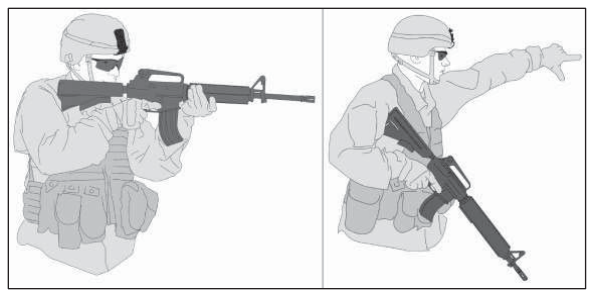
Tactics in CQC are diverse and must be adaptable to the fluid dynamics of close-range engagements. They include room-clearing techniques, where teams methodically and swiftly enter and secure areas within a building; hand signals and quiet communication to maintain stealth; and the use of cover and concealment to protect oneself while creating opportunities to engage the adversary. One of the key tactics is the element of surprise, which can often determine the outcome of a close-quarters engagement. By gaining the advantage of surprise, a smaller or technically inferior force can overcome a larger or better-equipped opponent.
Training
Training for CQC is rigorous and comprehensive, encompassing a wide range of skills that include marksmanship, hand-to-hand combat, small unit tactics, and stress management. Simulations and live exercises are conducted in mock-up environments that replicate real-world scenarios, preparing operatives to handle high-risk, high-stress situations effectively. This training emphasizes not only physical readiness but also mental resilience, leadership, and the ability to make quick, strategic decisions under pressure.
In the context of Close Quarter Combat (CQC), a "buddy team" or "fire team buddy system" is a fundamental tactical unit comprising two operators.
Psychology
The psychological aspect of CQC cannot be understated. The close proximity to the enemy, the potential for hand-to-hand combat, and the high stakes involved create a highly charged atmosphere that demands mental toughness and clarity. Combatants must be able to control fear, manage stress, and maintain a high level of focus to operate effectively.
Summary
In summary, Close Quarter Combat is a critical component of modern warfare and law enforcement operations, characterized by its emphasis on short-range engagements, rapid decision-making, and the strategic use of teamwork and tactics to achieve objectives. It requires a unique blend of physical prowess, mental strength, and technical skill, making it one of the most challenging and dynamic forms of combat.





 Battleground Archives
Leave a comment