
Napalm, a flammable liquid used in warfare, was first developed during World War II, by a set of discoveries by multiple teams and organizations; Harvard chemists led by Louis Fieser; Maurice Eugene Barker, head of research at U.S. Chemical Weapons Service; contractor firm Athur D. Little. The name Napalm is derived from its original components, naphthenic and palmitic acids, which were used to thicken gasoline. This innovation addressed the need for a more effective incendiary weapon that could adhere to surfaces and burn more intensely than regular gasoline. Napalm was initially created to enhance flamethrowers and incendiary bombs, making them more destructive and difficult to extinguish.
The first major use of napalm occurred in 1944, during the Pacific War. The U.S. military utilized it to clear dense vegetation and bunkers, and its psychological impact was significant, demoralizing enemy troops. Its effectiveness in destroying infrastructure and enemy fortifications led to widespread use in subsequent conflicts, including the Korean War and the Vietnam War.
During the Vietnam War, napalm became infamous for its devastating effects on civilian populations and the environment. The substance’s use in this conflict spurred significant controversy and anti-war protests. Iconic images, such as the photograph of Phan Thi Kim Phuc, a young girl running from a napalm attack, fueled public outrage and opposition to the war. The U.S. military’s use of napalm decreased after Vietnam, and its deployment in warfare became more restricted by international law.

In 1980, the United Nations Convention on Certain Conventional Weapons (CCW) sought to limit the use of incendiary weapons like napalm, particularly against civilian targets. Despite this, napalm-like substances have continued to see use in various conflicts, albeit often under different chemical formulations.
How Napalm Works
Napalm is essentially a gel that, when ignited, sticks to surfaces and burns intensely, producing extremely high temperatures. Its composition typically includes a gelling agent mixed with a volatile petrochemical, such as gasoline. The gelling agents used in modern variants can vary, but they are designed to increase the viscosity of the fuel, allowing it to cling to surfaces and burn longer.
The primary mechanism of napalm’s destructive power lies in its ability to generate extremely high temperatures and to sustain burning. When deployed, napalm ignites upon impact, and the sticky gel adheres to whatever it contacts, including human skin, buildings, and vegetation. The burning temperature can reach up to 1,500 to 2,000 degrees Fahrenheit (about 800 to 1,090 degrees Celsius), which is capable of inflicting severe burns, destroying structures, and causing fires to spread rapidly.
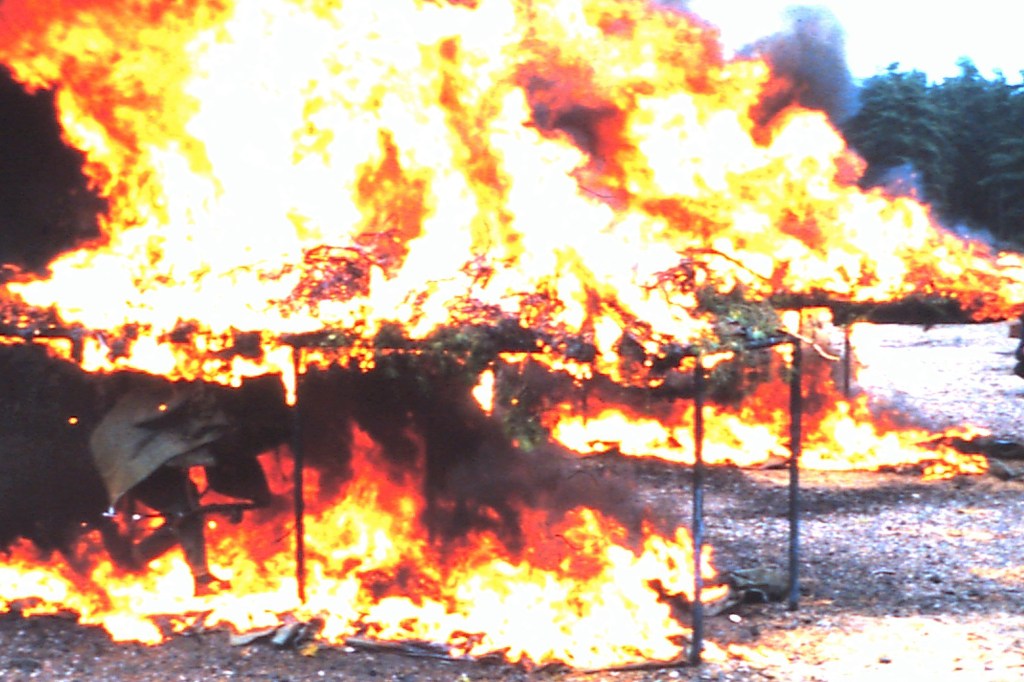
Additionally, napalm consumes oxygen in the vicinity as it burns, creating a suffocating environment. This aspect adds to its lethality in enclosed spaces, such as bunkers or buildings. The thick smoke produced by napalm fires can also serve to obscure vision and further disorient those affected.
In conclusion, napalm has a controversial history marked by its devastating effectiveness and the ethical concerns surrounding its use. While initially developed for military utility, its brutal impact, particularly on civilians, has led to significant international restrictions and debates about the ethics of its deployment in modern warfare.




 Battleground Archives
Leave a comment