
The history of mortars traces back several centuries, evolving from simple siege weapons to advanced, precision-guided systems used in modern warfare.
The concept of the mortar emerged in the late medieval period. The earliest mortars were simple, short-barreled devices designed to lob projectiles at high angles over fortifications. One of the first recorded uses was during the siege of Constantinople in 1453, where the Ottoman forces used large-caliber mortars to breach the city walls.
Mortars became more prevalent in European warfare during the 17th century. They were primarily used in sieges, lobbing explosive shells over defensive walls. The barrel length and caliber varied, but their role remained largely the same: to provide indirect fire support. Mortars were made of cast iron or bronze and required a large crew to operate.
The advent of trench warfare in World War I necessitated more portable and effective mortar designs. The British introduced the Stokes mortar, a revolutionary design by Sir Wilfred Stokes, in 1915. The Stokes mortar was lightweight, easily transportable, and could fire multiple rounds quickly. It set the standard for modern mortar design with its smoothbore barrel and drop-fire mechanism.
Sir Wilfred Stokes was a British engineer and inventor. He served as the Managing Director of Ransomes & Rapier, an engineering firm, and his innovations significantly impacted military tactics. Stokes was knighted in 1917 in recognition of his contributions to the war effort.
During World War II, mortars were an integral part of infantry units across all major armies. The United States military adopted the M2 60mm mortar, while the Germans used the Granatwerfer 34. Mortars were valued for their ability to provide high-angle fire in difficult terrain and were used for both offensive and defensive operations. The technology saw improvements in range, accuracy, and rate of fire.
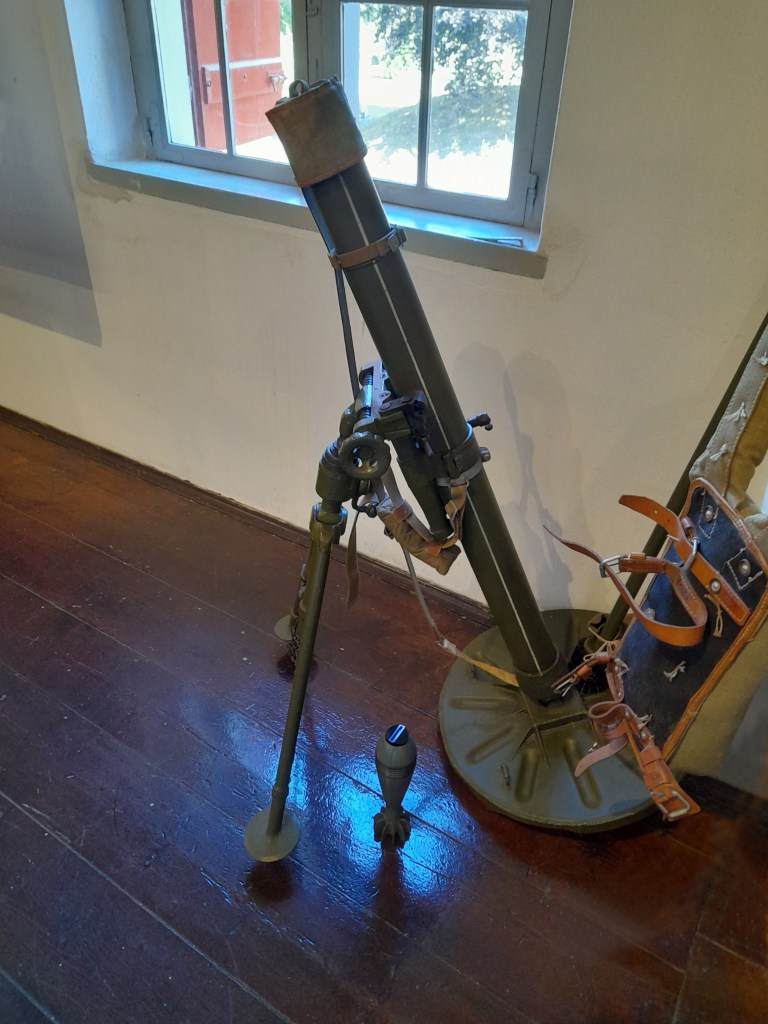
After World War II, mortar technology continued to evolve. Modern mortars are characterized by lightweight materials, improved firing mechanisms, and advanced sighting systems. They are now available in various calibers, including 60mm, 81mm, and 120mm, each serving different tactical roles. Mortars have also been adapted for vehicle mounting, increasing their mobility and versatility.
Components & Functionality
Mortars function as indirect fire weapons, capable of lobbing explosive projectiles at high angles to reach targets beyond line-of-sight obstacles. Its main components is a:
- Barrel: The mortar’s barrel is typically short and smoothbore, designed to launch projectiles at a steep angle.
- Base Plate: This provides stability and absorbs recoil when the mortar is fired.
- Bipod: Attached to the barrel, it allows for elevation and traverse adjustments.
- Sight: Modern mortars are equipped with optical or digital sights for aiming.
Mortar rounds are fin-stabilized and come in various types, including high-explosive, smoke, illumination, and guided rounds. The rounds are generally cylindrical with a propulsion system at the base.
The firing mechanism typically utilize the Drop Fire method. The most common method involves dropping a round down the barrel. When the round hits the firing pin at the base, the primer ignites the propellant, launching the round. Some mortars instead have a trigger mechanism that initiates the firing process once the round is loaded.
Mortar teams typically consist of several members: a gunner, assistant gunner, and ammunition bearers. The gunner adjusts the barrel’s elevation and traverse to aim, while the assistant gunner loads the rounds.
The effective range of mortars varies by caliber. For instance, a 60mm mortar might have a range of about 2,000 meters, while a 120mm mortar can reach up to 7,200 meters. Modern mortars are equipped with advanced sighting systems, and GPS-guided rounds have significantly improved accuracy.
Technological Advancements
Modern advancements in mortar technology include the development of automated mortar systems, like the CARDOM, which can be mounted on vehicles and provide rapid, accurate fire support. GPS and laser-guided rounds have enhanced precision, while lightweight composite materials have made mortars more portable. These advancements ensure that mortars remain a crucial component of modern artillery, capable of delivering versatile and effective indirect fire support in various combat scenarios.
CARDOM (Hatchet) is an advanced mortar system (Recoil Mortar System) developed by Soltam Systems, designed for high mobility and rapid deployment on various platforms, including soft-skinned vechicles like trucks. It features automated fire control for improved accuracy and efficiency, utilizing 81mm or 120mm munitions. The system is integrated with modern targeting technologies, making it a vital asset for mobile fire support in modern military operations. It uses advanced computerized navigation and self-positioning systems.







 Battleground Archives
Leave a comment