Battleship is a popular two-player strategy game that has been captivating players for decades. The essence of the game revolves around naval warfare, where players aim to sink their opponent’s fleet by guessing the locations of their ships on a hidden grid. The game is renowned for its simplicity, yet it offers a depth of strategy and suspense.
Mechanics
The game is played on two grids for each player, typically labeled as Player’s Grid and Opponent’s Grid. These grids are usually 10×10 squares, with rows labeled 1-10 and columns labeled A-J. At the start, each player secretly arranges their fleet on their own grid. The standard fleet consists of several ships of varying lengths: typically, an aircraft carrier (5 spaces), one or two battleships (4 spaces), a couple of cruiser or destroyers (3 spaces), and some submarines (2 spaces).
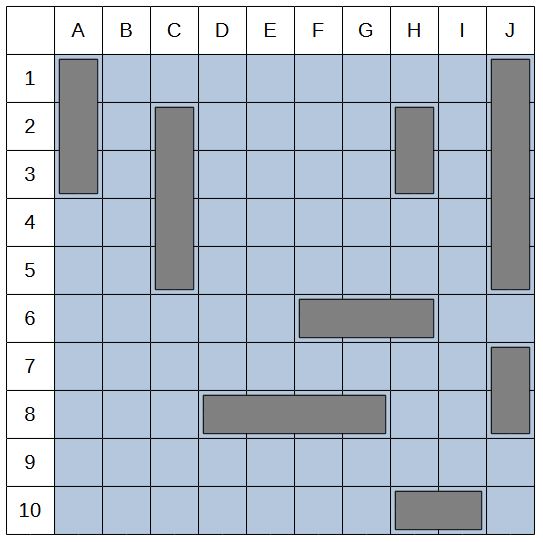
Players take turns calling out coordinates in an attempt to hit the opponent’s ships. For instance, a player might call B5, and the opponent must respond whether it is a hit or miss. If a ship occupies that space, it’s a hit; otherwise, it’s a miss. Players mark hits and misses on their Opponent’s Grid to keep track of their guesses. The objective is to sink all the opponent’s ships by hitting all the squares they occupy.
The game concludes when one player sinks all the ships of the other, thus winning the game. Although it involves some degree of chance, skilled players employ strategies such as targeting the most probable areas or adapting their search patterns based on initial hits.
Background
The origins of Battleship can be traced back to World War I, and it is believed that the game was originally played using pencil and paper. The game was known under various names, such as Salvo and Broadsides, and had different rule variations. It wasn’t until 1931 that the game was first commercially released as Salvo by the Starex company.
The modern version known as Battleship was developed by Milton Bradley (now a subsidiary of Hasbro) and released in 1967 as a plastic board game. This version introduced the now-familiar pegboards and pegs to mark hits and misses, adding a tactile and visual element to the game. The peg-based design also made it easier for players to manage and track their progress during gameplay.
In the late 1970s and 1980s, electronic versions of Battleship were introduced, incorporating lights and sounds to indicate hits and misses, enhancing the game’s appeal. The digital era further expanded Battleship’s reach, with various video game adaptations for computers, gaming consoles, and mobile devices.
Battleship has also made its mark in popular culture, featuring in movies, television shows, and even being the subject of a 2012 action film. Its simple yet engaging mechanics have made it a staple in households and a popular choice for teaching concepts like strategic thinking and probability.
Legacy and Impact
Battleship remains a beloved game for players of all ages. Its success lies in the blend of luck and strategy, making it accessible yet challenging. The game fosters critical thinking, as players must deduce ship positions based on incomplete information. Moreover, it has been used educationally to teach basic concepts of logic and reasoning.







 Battleground Archives
Leave a comment