
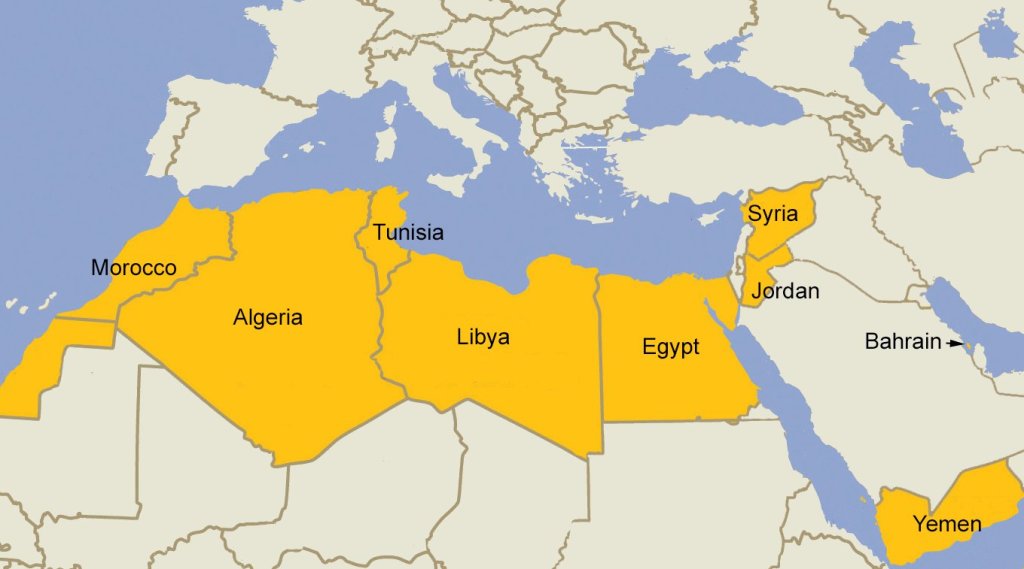
The Arab Spring was a series of pro-democracy uprisings that swept across the Arab world beginning in late 2010 and early 2011. It was a period marked by widespread protests, uprisings, and in some cases, armed rebellions that led to the overthrow of several long-standing authoritarian regimes. The movement started in Tunisia and rapidly spread to Egypt, Libya, Yemen, Syria, and other countries in the Middle East and North Africa.
The spark for the Arab Spring was the self-immolation of Mohamed Bouazizi, a young street vendor in Tunisia, on December 17, 2010. Bouazizi’s act was a protest against police corruption and ill-treatment, and it resonated with many Tunisians facing similar issues. His death became a catalyst for nationwide protests against unemployment, economic hardship, and political repression. The mass demonstrations eventually led to the ousting of President Zine El Abidine Ben Ali on January 14, 2011, after 23 years in power.
Mohamed Bouazizi was born on March 29, 1984, in Sidi Bouzid, Tunisia, and grew up in a poor family. He became the primary breadwinner at a young age, supporting his mother and siblings by working as an unlicensed street vendor, selling fruits and vegetables.
Several underlying causes contributed to the wave of unrest:
Authoritarianism and Political Repression: Many countries in the Arab world were (and is) ruled by authoritarian regimes that suppressed political dissent, restricted freedoms, and monopolized power. Citizens faced severe limitations on political participation and lacked basic human rights.
Economic Hardship and Inequality: High unemployment, especially among youth, widespread poverty, and economic inequality were significant factors. Many people struggled with rising food prices, lack of job opportunities, and poor living conditions, which fueled widespread discontent.
Corruption: Corruption was rampant in many Arab countries. Government officials often engaged in corrupt practices, and public resources were frequently misused, leading to public frustration and anger.
Demographic Pressures: The Arab world experienced a youth bulge, with a large proportion of the population being young people. This demographic pressure, combined with the lack of economic opportunities and political freedoms, created a volatile environment.
Social Media and Information Technology: The proliferation of social media and information technology played a crucial role in mobilizing and organizing protests. Platforms like Facebook, Twitter, and YouTube enabled activists to share information, coordinate activities, and raise awareness about their causes on a global scale.
Inspiration from Regional Events: The self-immolation of Mohamed Bouazizi sparked the Tunisian Revolution and became a symbol of resistance against oppressive regimes. The success of the Tunisian Revolution inspired similar movements across the region.
Long-standing Grievances: Many people had long-standing grievances related to social injustice, lack of political freedoms, and economic difficulties. The cumulative effect of these grievances over decades contributed to the eruption of the Arab Spring.
Inspired by Tunisia, Egyptians took to the streets on January 25, 2011, in what became known as the January 25 Revolution. The protests, centered in Cairo’s Tahrir Square, demanded the end of President Hosni Mubarak’s 30-year rule. Despite a violent crackdown, the protests grew, culminating in Mubarak’s resignation on February 11, 2011. This marked a significant victory for the Egyptian people and inspired further movements across the region.
In Libya, the unrest escalated into a full-blown civil war. Protests against Muammar Gaddafi’s 42-year rule began in February 2011 and quickly turned violent. The opposition formed the National Transitional Council and received international support, including NATO intervention. After months of intense fighting, Gaddafi was captured and killed in October 2011, leading to the collapse of his regime.
Muammar Gaddafi was born on June 7, 1942, near Sirte in Italian Libya, into a Bedouin family from the Qadhadhfa tribe. He grew up in a rural environment, experiencing the traditional nomadic lifestyle of his tribe. Gaddafi's early life in the desert, marked by a strong sense of Arab nationalism and anti-colonial sentiment, deeply influenced his political ambitions. He was the leader of Libya from 1969 to 2011, having seized power in a military coup that overthrew King Idris I. Gaddafi ruled as an authoritarian dictator, implementing his own political philosophy known as the Third International Theory, which combined aspects of socialism and Islam.
Yemen also experienced significant upheaval. Protests against President Ali Abdullah Saleh, who had been in power for 33 years, began in January 2011. The demonstrations intensified despite violent crackdowns, leading to a political crisis. In November 2011, Saleh agreed to transfer power to his vice president, Abd-Rabbu Mansour Hadi, in exchange for immunity. However, Yemen’s transition was marred by ongoing violence and the emergence of the Houthi rebellion, leading to a protracted civil conflict.
The Houthis, officially known as Ansar Allah (Supporters of God), are a Yemeni Shia Muslim movement that emerged from the Zaidi sect in the 1990s. They originated in the northern Saada province under the leadership of Hussein Badreddin al-Houthi, initially focusing on local grievances and resistance against perceived government oppression and Saudi influence. The Houthis gained international attention during the Yemeni Civil War, which began in 2014 when they seized the capital, Sanaa, and have since been involved in a complex conflict involving regional powers, including Saudi Arabia and Iran.
In Syria, the situation devolved into one of the most brutal and complex conflicts of the Arab Spring. Protests against President Bashar al-Assad’s regime began in March 2011, calling for political reforms and the release of political prisoners. The government’s harsh response, including military assaults on demonstrators, led to an armed rebellion. The conflict evolved into a multi-sided civil war involving various factions, including ISIS, and drew in international actors like Russia, the United States, and Iran. The war has resulted in a massive humanitarian crisis with millions of displaced persons and significant loss of life.
The Arab Spring also saw significant but less intense movements in countries like Bahrain, Jordan, Morocco, and Algeria. In Bahrain, protests were primarily driven by the Shia majority seeking greater political freedom and equality from the Sunni monarchy. The Bahraini government, with support from Saudi Arabia, suppressed the uprising.
While the Arab Spring initially generated hope for democratic transformation, the outcomes have been mixed. Tunisia is often cited as a success story, having established a functioning democracy. In contrast, Egypt reverted to authoritarian rule, Libya and Yemen remain embroiled in conflict, and Syria’s war continues with devastating consequences. The Arab Spring highlighted deep-seated issues in the region, including governance, economic disparity, and human rights, but the path to resolving these challenges remains complex and ongoing.




 Battleground Archives
Leave a comment