
Contact mines, a critical component in naval warfare, are designed to detonate upon physical contact with a ship or submarine, serving as an element in both defensive and offensive maritime strategies.
Early Developments
The Chinese are credited with some of the earliest forms of naval mines. During the Song Dynasty, military engineers developed one such device that consisted of a wooden box filled with gunpowder, which would be detonated by a slow-burning fuse. These early mines were rudimentary but represented significant technological innovation.
The Song dynasty, spanning from 960 to 1279 AD, was a period of Chinese history marked by significant cultural, economic, and technological advancements. It is divided into the Northern Song (960–1127), which had its capital in Bianjing (modern-day Kaifeng), and the Southern Song (1127–1279), which ruled from Lin'an (modern-day Hangzhou) after losing northern territories to the Jurchens. The dynasty is renowned for its developments in arts, literature, and inventions such as gunpowder, the compass, and movable type printing.
The Ming Dynasty saw further advancements in Chinese mine technology. Texts from this period describe floating mines made of bamboo and metal, filled with gunpowder, and ignited by a mechanism triggered by passing ships.
The Ming dynasty, which lasted from 1368 to 1644 AD, was a period of Chinese history known for its strong central government, flourishing culture, and extensive trade. Founded by Emperor Hongwu, it succeeded in overthrowing the Mongol-led Yuan dynasty and restoring Han Chinese rule. The Ming era is celebrated for its advancements in art, literature, and architecture, as well as for notable maritime explorations led by the admiral Zheng He.
The Huolongjing, a military treatise written by Jiao Yu and Liu Bowen in the 14th century, documents various explosive devices, including naval mines.
During the Renaissance, Leonardo da Vinci sketched designs for underwater explosives, although there is no evidence that these designs were ever built or tested.
In the 16th and 17th centuries, Dutch engineers experimented with underwater explosives, including primitive forms of sea mines, to protect their waterways and harbors.
David Bushnell
The invention of the Contact Mine is attributed to David Bushnell, an American inventor renowned for his pioneering work in underwater warfare. Bushnell, who also created the first combat submarine, the Turtle, developed the concept of the contact mine during the American Revolutionary War.
David Bushnell was born on August 30, 1740, in Westbrook, Connecticut. He attended Yale College, where he developed an interest in mechanics and underwater navigation.
In 1777, Bushnell devised what is considered the first contact mine. These early mines were essentially kegs filled with gunpowder and equipped with a mechanical trigger to detonate upon contact with a ship. Bushnell’s mines were part of an operation known as the Battle of the Kegs in January 1778, where several mines were released into the Delaware River to target British ships in Philadelphia. Although the operation was not highly successful, it marked a significant step in the development of underwater explosive devices.
The American Revolutionary War (1775-1783) was a conflict between the Thirteen American Colonies and Great Britain. The war was driven by the colonies' growing dissatisfaction with British rule, particularly regarding issues of taxation without representation, lack of political autonomy, and British interference in colonial affairs.
19-20th Century Evolution
During the Napoleonic Wars, Russian engineer Pavel Schilling developed an early form of electrically detonated underwater mine, which was tested in the Baltic Sea. In this period, Austrian engineer Franz von Hoffer also made significant contributions to mine technology, including improvements to contact mines.
During the American Civil War, Confederate forces utilized contact mines extensively. Key figures in the development and deployment of these mines included Confederate naval officers like Hunter Davidson and engineers such as Edmund Charles Singer. Their efforts helped establish the use of contact mines as a formidable tool in naval warfare.
Hunter Davidson was born on August 12, 1826, in Georgetown, Washington, D.C. He entered the United States Naval Academy in 1841 and graduated in 1847. When the American Civil War broke out in 1861, Davidson, like many naval officers from the Southern states, resigned his commission in the United States Navy to join the Confederate Navy.
The concept of the contact mine was further refined throughout the 19th and early 20th centuries, with significant advancements improving their reliability and effectiveness.
The Russo-Japanese War (1904-1905) highlighted the strategic importance of contact mines, as Russian forces successfully employed them to sink Japanese battleships. This demonstrated the effectiveness of mines in modern naval conflicts.
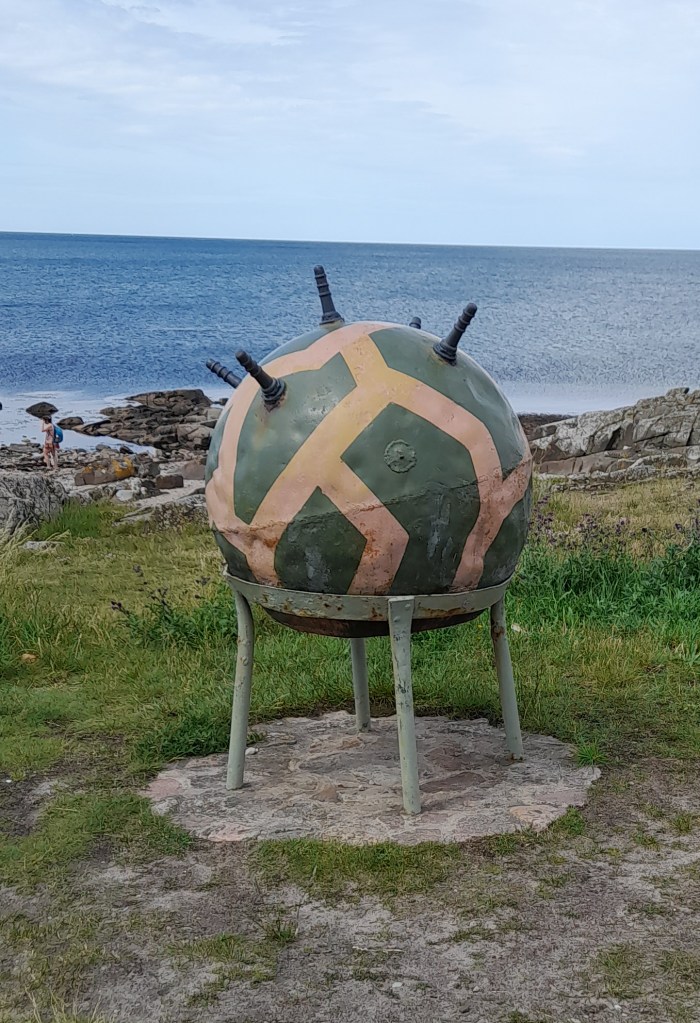
The extensive use of contact mines in World War I and World War II marked a period of significant technological advancements. Mines were mass-produced and deployed widely, with innovations such as the Hertz horn—containing a glass vial of electrolyte that would complete an electrical circuit and detonate the mine upon contact—greatly enhancing their reliability.
Modern Applications
Post-World War II, contact mines have continued to evolve, incorporating more advanced technologies. Modern contact mines are designed as part of comprehensive mine warfare systems, often in conjunction with mines that use acoustic, magnetic, and pressure sensors to detect and target vessels without direct contact. These modern mines are made from materials that reduce detectability by mine countermeasure vessels and are more resistant to environmental conditions.
Today, contact mines remain a vital component of naval arsenals worldwide, deployed from submarines, aircraft, and remotely operated vehicles. These advanced deployment methods enhance the strategic flexibility of mine warfare, allowing for rapid and covert placement in enemy waters.






 Battleground Archives
Leave a comment