Explosives are crucial for a variety of operations, including demolition, breaching obstacles, and neutralizing enemy fortifications. In military contexts, fieldworks are often designed to delay enemy mobility. These include:
- Blocking: Preventing the opponent’s movement within a short timespan, typically minutes to hours.
- Obstruction: Delaying enemy movement for a few hours to a day.
- Destruction: Creating obstacles to delay the enemy for longer periods, from a day to several weeks.
Additionally, fieldworks may involve mining and creating barriers.
The purposes of these fieldworks are to:
- Decrease the enemy’s pace of movement
- Inflict enemy losses
- Maintain combat economy and preserve own combat effectiveness
- Divert or force the enemy in a direction favorable for own operations and weapon systems
- Achieve local superiority
- Support concentration of forces in one direction even if the enemy attacks from multiple locations
The basic components of explosives typically used in these operations include fuse cords, blasting caps, detonating cords, and plastic explosives. Each component has a specific role in the construction and deployment of explosive devices.
Fuse Cord

The fuse cord is a piece of cord filled with a slow-burning powder, such as black powder (gunpowder), composite propellants, nitrocellulose-based powder. Its primary function is to provide a timed delay before the main explosive charge detonates. This delay allows the user to retreat to a safe distance. The burn rate of the fuse cord is typically measured in seconds per centimeter, ensuring a predictable and reliable delay. Fuse cords are often used in scenarios where electronic timing devices are impractical, providing a simple and robust means of initiating an explosive sequence. The cord is sensitive to impact, petroleum, kerosene, moisture, and strong sunlight or heat. Cords must not be bent sharply or knotted.
Blasting Cap

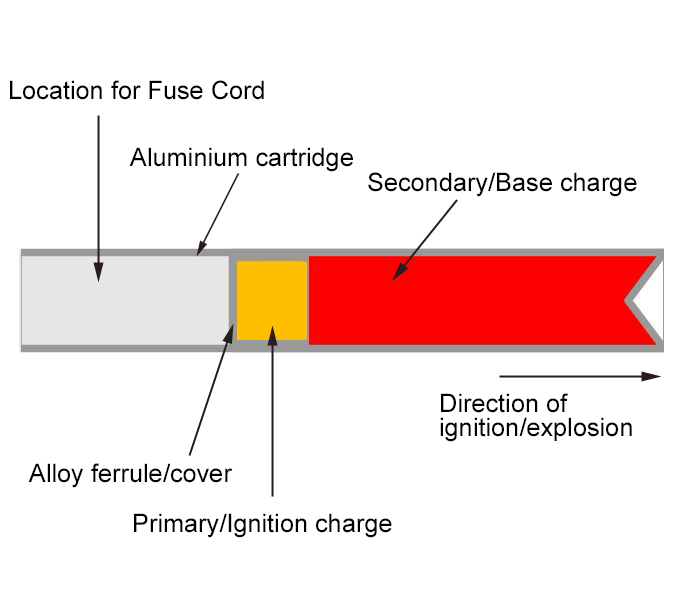
The blasting cap is a small, sensitive device used to trigger the main explosive charge. It contains a primary explosive that is highly sensitive to heat, shock, or friction, which then ignites the secondary, less sensitive explosive charge. Blasting caps are crucial because they provide a reliable means of initiating the main charge. There are two primary types: electric and non-electric. Electric blasting caps are initiated by an electric current, while non-electric caps are typically ignited by a fuse or shock tube. They are used to ensure a precise and controlled detonation of the main explosive charge.
Detonating Cord
A detonating cord is a high-explosive-filled cord used to transmit a detonation wave from one point to another. It contains a core of PETN (Pentaerythritol Tetranitrate), a powerful explosive, which ensures a high-speed and reliable transfer of the detonation wave. Detonating cords are used to synchronize multiple explosive charges, ensuring they detonate simultaneously or in a precise sequence. It is highly versatile and can be cut to length, tied, or wrapped around charges, making it an essential tool for complex demolition tasks.
Plastic Explosive
A plastic explosive is a malleable, dough-like substance, similar in texture to a piece of almond paste, but becomes more sticky when handled/heated. It can be easily shaped and molded. The most well-known plastic explosive is C-4, which contains RDX (Research Department Explosive) as its primary ingredient. Plastic explosives are valued for its versatility and ease of handling. It can be pressed into crevices, wrapped around objects, or shaped to direct the force of the explosion.

Its stable nature makes it safe to handle under a variety of conditions, but it requires a detonator, such as a detonating cord, to initiate the explosion. This makes it ideal for controlled demolitions, breaching operations, and special forces missions where precision and reliability are paramount.
Integration and Application
In military operations, these components are often used together to create a reliable and effective explosive device. A typical setup might involve attaching a Blasting Cap to a Detonating Cord, that is placed in a charge of Plastic Explosive, with a Fuse Cord or electric wire attached to initiate the cap. Detonating cords can be used to connect multiple charges, ensuring simultaneous or sequential detonation. This integration allows for a wide range of explosive effects, from precise cutting charges to large-scale demolitions.







 Battleground Archives
Leave a comment