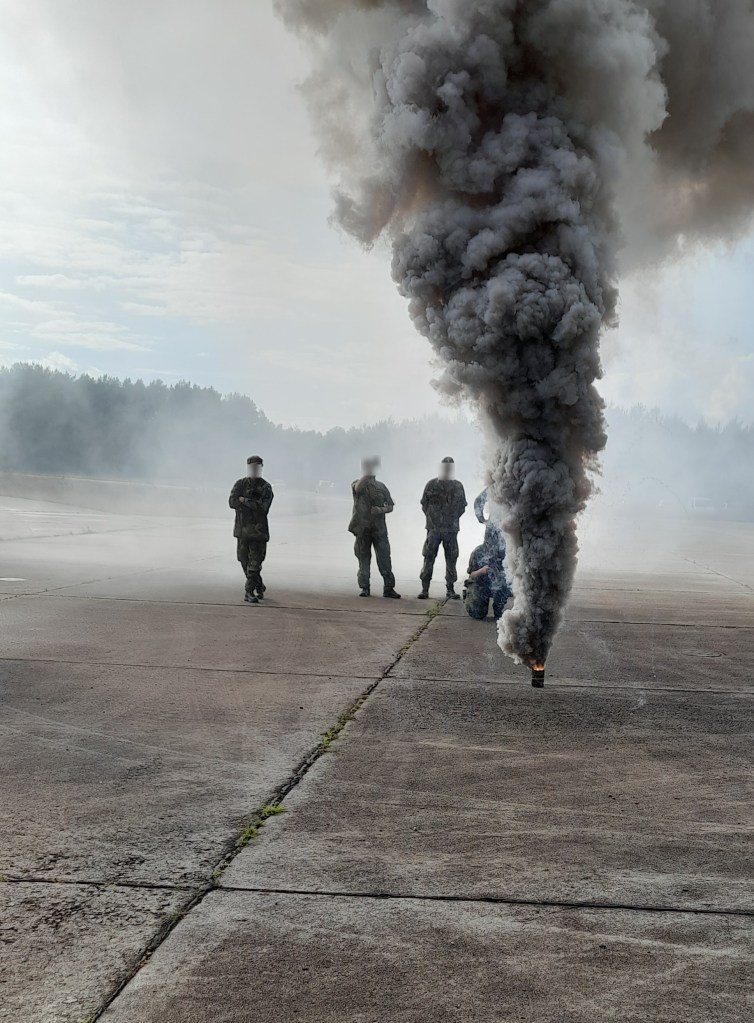
Smoke canisters, or smoke grenades, are tactical devices used in military operations to create a smoke screen. These screens are used to obscure vision, provide cover, signal, or mark positions. The most common type of smoke grenade used by the US military is the M18, which can generate a dense cloud of colored or white smoke.
Contents and Mechanism
Smoke grenades typically contain a chemical composition that produces smoke when ignited. The primary component is a fuel-oxidizer mixture, such as zinc chlorice, hexachloroethane, potassium chlorate mixed with lactose or a similar sugar-based fuel. Additionally, dyes are added to produce colored smoke, with specific dyes for different colors like red, green, yellow, or violet. The M18 grenade, for example, uses these dye components to create the desired smoke color for signaling or marking purposes.
The grenade is ignited by a friction igniter. When the pin is pulled, the igniter initiates a burning fuse that ignites the chemical mixture inside the canister. This ignition causes a rapid combustion reaction, producing a thick cloud of smoke. The design of the canister ensures that the smoke is released through multiple small holes or vents, allowing it to disperse evenly and create an effective smoke screen.
Usage in Military Operations
Concealment and Cover
One of the primary uses of smoke grenades in military operations is to provide concealment. In combat, soldiers use smoke screens to obscure their movements from the enemy, making it difficult for adversaries to aim or locate their positions. This is particularly useful during maneuvers like crossing open ground, retreating from a position, or advancing under fire. The smoke creates a visual barrier, reducing the risk of being targeted by direct fire or observation.
Obscuring Enemy Vision
Smoke grenades are also used to obscure enemy vision, both from the ground and from aerial surveillance. By creating a smoke screen, forces can hinder the enemy’s ability to gather intelligence or coordinate attacks. This is especially effective against snipers, machine gunners, and artillery spotters, as the smoke can block their line of sight and disrupt their ability to accurately target friendly forces.
Signaling and Marking
Different colors of smoke are used for signaling and marking purposes. For instance, colored smoke can be used to mark landing zones for helicopters, designate targets for airstrikes, or indicate the location of friendly forces to avoid friendly fire. Each color has specific meanings, and the choice of color depends on the pre-established communication protocols within the military unit.
Psychological Impact
The use of smoke can have a psychological impact on both friendly and enemy forces. For friendly forces, it can provide a sense of security and boost morale by offering a temporary shield against enemy observation and fire. For the enemy, the sudden appearance of a smoke screen can cause confusion, disrupt their plans, and force them to react or reposition, potentially giving the deploying force a tactical advantage.
Situational Deployment
Smoke grenades are employed in various scenarios, including urban warfare, open-field battles, and during retreats or advances. In urban settings, smoke can obscure streets and building lines, allowing troops to move between cover. In open fields, it provides protection when moving across exposed areas. During tactical retreats or advances, smoke can cover troop movements, making it difficult for the enemy to mount an effective response.
Disruption of Infrared (IR) and Thermal Imaging
The dense smoke produced by smoke grenades can to some extent scatter and absorb infrared light, which is used by many IR sensors and cameras. This scattering and absorption reduce the effectiveness of IR imaging, making it harder to see through the smoke. Thermal imaging works by detecting the heat emitted by objects. The smoke can obscure thermal imaging in several ways:
- Physical Obstruction: The smoke creates a physical barrier that can block the line of sight of thermal cameras.
- Temperature Masking: Some smoke grenades are designed to produce smoke that is close to the ambient temperature, which can mask the thermal signatures of objects behind the smoke cloud.
- Scattering and Absorption: Similar to IR, the particles in the smoke can scatter and absorb thermal radiation, reducing the clarity and effectiveness of thermal imaging.
Thermal imaging and IR (infrared) imaging are related but distinct technologies. Thermal imaging specifically detects and visualizes heat emitted by objects, focusing on temperature variations, and typically operates in the long-wave infrared (LWIR) range of 8 to 14 micrometers. In contrast, IR imaging encompasses a broader spectrum, including near-infrared (NIR), short-wave infrared (SWIR), mid-wave infrared (MWIR), and LWIR, and is used for various applications such as night vision, material inspection, and remote sensing. While thermal imaging produces color-coded images based on temperature, IR imaging can produce images based on different infrared wavelengths and their specific applications. Essentially, thermal imaging is a specialized subset of the broader IR imaging technology.
Effectiveness
The effectiveness of smoke grenades in disrupting IR and thermal imaging depends on several factors: Thicker, denser smoke provides better obscurance (Smoke Density). Certain chemicals are more effective at absorbing and scattering IR and thermal radiation (Smoke Composition). Wind, temperature, and humidity can affect the dispersion and density of the smoke cloud (Environmental Conditions).
The smoke cloud typically lasts only few minutes, providing temporary obscurance. The effectiveness is obviously limited to the area covered by the smoke cloud. Finally, some advanced IR and thermal imaging systems may have partial capabilities to see through smoke or mitigate the effects of smoke.




 Battleground Archives
Leave a comment