
Suppressors, commonly known as silencers, have a history intertwined with firearms development and military tactics. Dating back to the late 19th century, these devices have evolved from rudimentary designs to sophisticated pieces of engineering, offering not only noise reduction but also improved accuracy and recoil control.
The concept of firearm suppression emerged in the late 19th century, driven by the need for stealth and reduced noise in military and law enforcement operations. The first patented suppressor design was developed by Hiram Percy Maxim in 1909, known as the Maxim Silencer. It featured a series of expansion chambers and baffles to slow down and cool escaping gases, effectively reducing the noise produced by firing a firearm. Initially marketed for hunting and recreational shooting, suppressors gained traction in military applications during World War I. They were used by special operations units for clandestine missions and by snipers to mask their shots and maintain concealment.
Hiram Percy Maxim was born on September 2, 1869, in Brooklyn, New York, to Sir Hiram Stevens Maxim, a famous inventor known for creating the Maxim machine gun, and his wife Jane Budden. Growing up in a family of inventors, Maxim was exposed to innovation from a young age. He studied at the Massachusetts Institute of Technology (MIT) and later worked alongside his father, assisting with various inventions and projects.
During World War II, suppressors saw widespread use among various military forces, particularly in commando units and special operations teams. The British Special Operations Executive (SOE) and the American Office of Strategic Services (OSS) issued suppressed weapons to operatives engaged in covert operations behind enemy lines. The suppressors provided these operatives with a tactical advantage, allowing them to engage enemy targets quietly and without revealing their positions. This contributed to the success of sabotage missions, reconnaissance activities, and guerrilla warfare tactics employed during the conflict.
Following World War II, suppressor technology continued to advance, with improvements in materials, design, and manufacturing processes. Modern suppressors are typically made from lightweight and durable materials such as aluminum, titanium, or stainless steel. They feature intricately designed baffles and expansion chambers that efficiently dissipate gases and reduce muzzle blast and recoil. Some suppressors also incorporate advanced sound-dampening materials to further attenuate noise and minimize the shooter’s auditory signature.

Functionally, suppressors work by capturing and cooling the high-pressure gases expelled from the muzzle of a firearm when it is fired. As the gases pass through the suppressor, they are directed into a series of baffles or expansion chambers, where they undergo rapid expansion and deceleration. This process disrupts the flow of gases and dissipates their energy, resulting in a significant reduction in noise and muzzle blast. Even though there are Compensators specifically aimed at decreasing muzzle rise, suppressors can help improve accuracy by reducing muzzle rise as well and recoil, allowing shooters to maintain better control and follow-up shots.
Types
Monolithic and modular suppressors are two different designs of firearm suppressors, each with its own advantages and disadvantages.
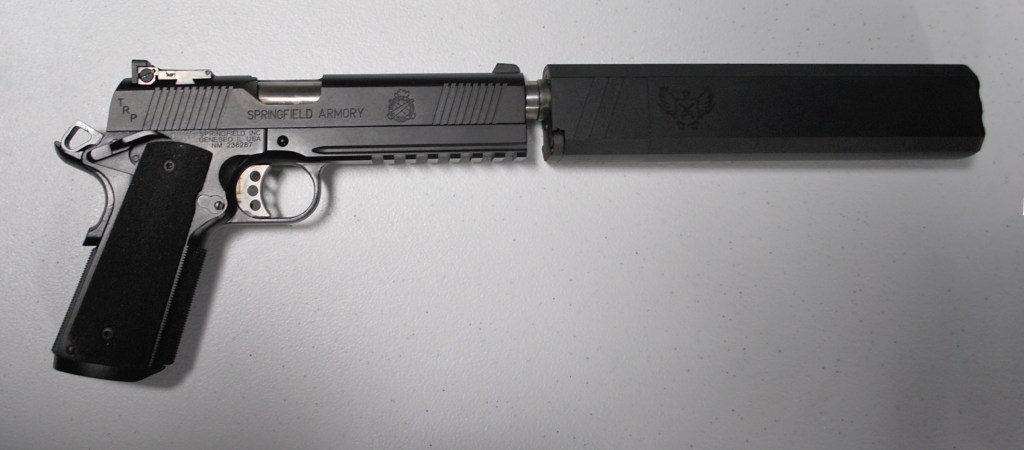
Monolithic Suppressors: Monolithic suppressors are constructed from a single piece of material, typically aluminum or titanium. They are often lighter and more compact compared to modular suppressors. Monolithic suppressors offer simplicity in design and construction, which can result in greater durability and reliability. However, because they are a single piece, there’s limited customization or adjustment available.
Modular Suppressors: Modular/Stacked suppressors are composed of multiple interchangeable parts, such as baffles, end caps, and extension modules. This modular design allows for greater flexibility and customization. Users can adjust the length, weight, and sound suppression characteristics by adding or removing modules or changing components. Modular suppressors are often favored for their versatility, as they can be configured to suit different firearms and shooting needs. However, the added complexity of modular suppressors can sometimes result in increased maintenance requirements and potential points of failure.
Captive-piston Slilencers: A captive-piston silencer is a type of firearm suppressor that utilizes a unique mechanism to reduce the sound of the gunshot. Unlike traditional baffle-based suppressors, which use baffles or chambers to slow and cool escaping gases, a captive-piston silencer employs a piston system to achieve sound suppression.
The core of a captive-piston silencer is a movable piston located inside the suppressor’s main body. This piston is usually spring-loaded. When a firearm is discharged, high-pressure gases are generated by the burning gunpowder. These gases push the bullet down the barrel and also expand rapidly once the bullet exits the muzzle. As the bullet passes through the suppressor, the expanding gases enter the suppressor’s main chamber. The pressure from these gases forces the piston backward against its spring. The movement of the piston helps to slow down and redirect the flow of gases inside the suppressor, reducing the noise produced by the escaping gases. Additionally, the piston absorbs some of the kinetic energy of the gases, further dampening the sound. Once the pressure inside the suppressor decreases to a certain level, typically after the bullet has left the muzzle, the spring pushes the piston back into its original position, readying the suppressor for the next shot.
Captive-piston Ammunition: There is also a specific type of firearm ammunition known as supersonic ammunition with integrated sound suppression or captive-piston ammunition. This innovative ammunition incorporates a built-in suppressor mechanism within the projectile itself, providing some level of sound suppression directly at the source.
Subsonic Ammunition: Subsonic ammunition is another method used to reduce the sound signature of firearms. Subsonic ammunition is designed to have a lower velocity than standard or supersonic ammunition, which results in less noise when fired. Subsonic ammunition, traveling at speeds below the speed of sound, eliminates or reduces this sonic boom, resulting in a quieter shot.
Frequency Shifting Suppressors: An advances type of suppressors are the Frequency Shifting Suppressors or Phase Cancellation Supressors. Both are designed to work in conjunction with traditional suppression methods, such as baffles, expansion chambers, and internal materials that absorb or dissipate sound energy. By incorporating these advanced techniques, suppressor manufacturers aim to achieve greater levels of sound reduction while maintaining overall performance and reliability. They work by modifying the sound waves generated by the blast, making the flow of gases to collide and passing through precision-made holes.
In addition to military and law enforcement applications, suppressors have gained popularity among civilian shooters for recreational shooting, hunting, and competitive shooting sports. They offer numerous benefits, including hearing protection, reduced noise pollution, and enhanced shooting comfort. Despite their widespread use, suppressors remain subject to regulation in many countries, with varying laws and restrictions governing their sale, possession, and use..







 Battleground Archives

Leave a comment