
The Israel War of Independence was a significant conflict that occurred in the wake of the United Nations Partition Plan for Palestine in 1947. Lasting from 1947 to 1949, the war resulted in the establishment of the modern State of Israel.
Following World War I, the League of Nations granted Britain a mandate to govern Palestine, which was then part of the Ottoman Empire. However, tensions between Jewish and Arab communities escalated under British rule, with both groups seeking self-determination.
The League of Nations was an international organization founded in 1920 with the goal of promoting peace, cooperation, and diplomacy among nations in the aftermath of World War I. It served as a precursor to the United Nations. It was dissolved in 1946.
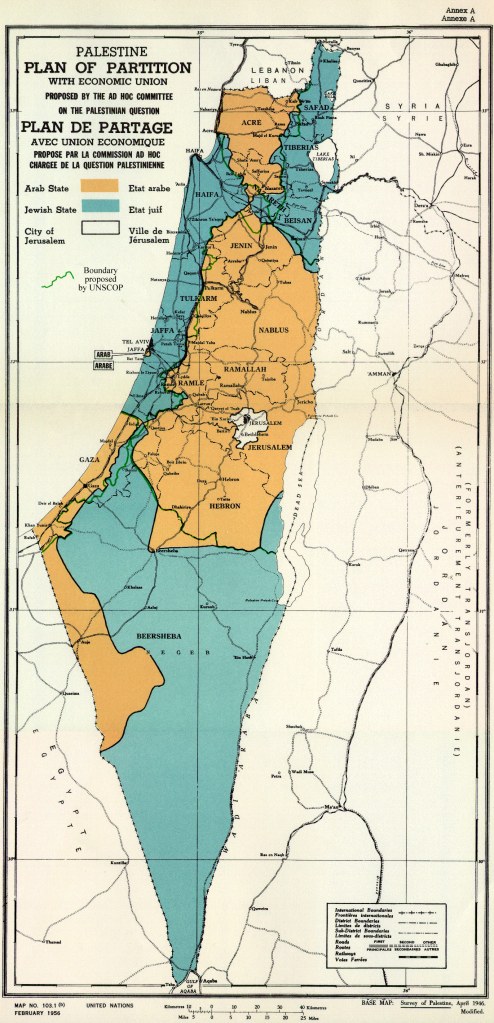
In 1947, the United Nations proposed a partition plan for Palestine, which aimed to create separate Jewish and Arab states, with Jerusalem as an international city. While Jewish leaders accepted the plan, Arab leaders rejected it, viewing it as unjust and discriminatory.
On May 14, 1948, David Ben-Gurion, the head of the Jewish Agency, declared the establishment of the State of Israel, just hours before the expiration of the British Mandate over Palestine. This declaration was met with immediate hostility from neighboring Arab states, which rejected the legitimacy of the new Jewish state.
_-_YITZHAK_RABIN_AS_YOUNG_PALMACH_COMMANDER_ON_TOUR_OF_NEGEV_WITH_DAVID_BEN_GURION_AND_YIGAL_ALLON..jpg)
In response to Israel’s declaration of independence, armies from Egypt, Jordan, Syria, and Iraq invaded the newly established state, aiming to prevent the creation of a Jewish state and to assert control over Palestine. The invasion marked the beginning of open hostilities between the Arab states and the nascent Israeli government.
In the early stages of the war, Israeli forces faced heavy resistance from Arab armies, which outnumbered and outgunned them. Arab forces launched coordinated attacks on multiple fronts, aiming to overwhelm Israeli defenses and capture key territories. Despite being outnumbered and facing superior firepower, Israeli forces employed innovative tactics and strategic maneuvering to gain the upper hand in the conflict. They launched preemptive strikes against Arab military installations, disrupted supply lines, and utilized guerrilla warfare tactics to harass enemy forces.
As the war progressed, Israeli forces launched counteroffensives and offensives aimed at securing key objectives and expanding territorial control. They achieved significant victories in battles such as Operation Nachshon, Operation Hiram, and Operation Yoav, which allowed them to capture strategic areas and push back Arab forces.
Operation
Operation Nachshon was one of the first major offensives launched by the Haganah, the main Jewish paramilitary organization in Palestine at the time. The operation, which became the first step in Plan Dalet, was aimed to secure vital supply routes to the besieged Jewish communities and to break the Arab siege of Jerusalem. The name Nachshon can be dervied from the biblical character Nachshon Ben Aminadav, who was the first to step into the Red Sea when the Jews fled Egypt (Exodus 14:21-22).
Arab forces launched a concerted effort to isolate and besiege the Jewish neighborhoods in western Jerusalem. The main road to the city was cut off by Syrian nationalist Abd al-Qadir al-Husayni’s troops, leaving the Jewish population vulnerable to shortages of food, water, and ammunition.
Jerusalem held immense symbolic and strategic significance for both Jewish and Arab communities. Control of the city was seen as vital for the establishment of a Jewish state, and its loss would have dealt a severe blow to the morale of the Jewish population.
The primary objective of Operation Nachshon was to break the Arab siege of Jerusalem and to secure access to the city for Jewish convoys carrying essential supplies and reinforcements. The operation aimed to open up a land corridor linking Jerusalem to Jewish-held areas along the coast. Jewish forces sought to capture key strategic positions along the road to Jerusalem and to establish control over critical high ground overlooking the supply routes. These positions would serve as bases for further operations and as defensive positions against Arab counterattacks.
The composition of forces on both sides was fluid and included additional units or formations as the situation evolved during the course of the operation. The main Jewish paramilitary organization, the Haganah mobilized several of its key units for the operation, including Palmach (the elite strike force known for its specialized training and combat capabilities), Hish units (regular infantry units responsible for frontline combat operations), and Notrim (Jewish police units that also participated in military operations and defense efforts). On the Arab side, various militias and irregular forces participated in the fighting, including the Arab Liberation Army (ALA, a coalition of Arab militias and volunteers from neighboring Arab countries), and Palestinian Arab militias (Local paramilitary groups).
Execution
The operation began on the night between April 5-6, 1948, with coordinated offensive actions by Jewish forces against Arab positions along the road. Haganah units launched attacks on Arab villages and strongholds, aiming to clear the way for Jewish convoys and to secure the supply routes.
They were faced with determined resistance from Arab militias and irregular forces. The fighting was characterized by intense skirmishes, ambushes, and exchanges of fire along the road and in the surrounding areas. Arab fighters utilized tactics such as sniper fire, booby traps, and improvised explosives to impede the progress of Jewish forces and inflict casualties.
Despite these challenges, Jewish units pressed forward, engaging in close-quarters combat and launching coordinated assaults on Arab strongholds. They employed combined arms tactics, including infantry assaults supported by artillery fire and armored vehicles, to dislodge Arab defenders and clear the way for advancing convoys.
Combined arms tactics gained prominence during World War I with the integration of infantry, artillery, and armored vehicles. It was further refined during World War II, where air power became a crucial component, leading to the development of doctrines like Blitzkrieg by the German military and AirLand Battle by NATO forces during the Cold War. Modern warfare continues to emphasize the importance of combined arms tactics, with advancements in technology and tactics continually shaping how different military branches collaborate on the battlefield.
The fighting was fierce and often chaotic, with both sides sustaining significant casualties, figures vary as much as being several hundereds to thousands.
Despite facing fierce opposition, Operation Nachshon achieved its objectives, and Jewish forces succeeded in opening up a temporary supply route to Jerusalem. The operation provided much-needed relief to the besieged Jewish communities in the city and bolstered morale among the Jewish population.
Operation Nachshon is celebrated as a symbol of Jewish resilience and determination in the face of adversity. The successful breaking of the siege of Jerusalem was a significant turning point in the Israel War of Independence and demonstrated the military capabilities of the nascent Jewish state. It set the stage for further offensives and operations aimed at securing Jewish territorial objectives and establishing the State of Israel on a firm footing.
Burma Road
In response to the Arab siege, Israeli forces launched an ambitious construction project to create a new supply route to Jerusalem. The road, which came to be known as the Burma Road, was built through rugged terrain and challenging conditions, with Jewish laborers and engineers working around the clock to complete the project.
The construction of the road required innovative engineering solutions to overcome natural obstacles such as steep hills, rocky terrain, and narrow passages. Israeli engineers utilized dynamite, bulldozers, and manual labor to carve out the road through the Judean Hills, bypassing Arab-held territory and hostile positions.
Operation Nachshon played a crucial role in paving the way for the construction of a more solid supply line to the Jewish population of Jerusalem. While the operation took place in April 1948, the construction of the road began shortly thereafter, in early May 1948. The operation aimed to break the Arab siege of Jerusalem and secure vital supply routes to the city, which were essential for its survival. The operation’s success highlighted the urgent need for a reliable and permanent supply route to Jerusalem, leading to the decision to construct the Burma Road.
During Operation Nachshon, Jewish forces managed to temporarily alleviate the siege by opening up a narrow supply corridor to Jerusalem. However, this corridor was not sustainable in the long term, as it was vulnerable to Arab attacks and could not support the volume of supplies needed to sustain the city’s population. The construction of the road was therefore seen as a strategic imperative to establish a more secure and efficient supply route.
The success of Operation Nachshon provided Jewish forces with a strategic advantage and allowed them to consolidate their gains in the area. By securing control over key territories and clearing the way for the construction of the road, Jewish forces set the stage for further offensives and operations aimed at breaking the siege definitively and securing Jerusalem.






 Battleground Archives
Leave a comment