
The history of body armor dates back thousands of years, with early examples of protective gear being used by ancient civilizations for combat and warfare.
Some of the earliest forms of body armor consisted of layers of leather or animal hide worn by ancient warriors to provide protection against cuts and blows from weapons. Metal armor, such as bronze and iron cuirasses and helmets, became widespread in ancient civilizations like Greece and Rome. These suits of armor offered improved protection against slashing and stabbing weapons.

Chainmail, consisting of interlinked metal rings, became prevalent during the Middle Ages. It offered flexible protection against slashing and piercing weapons and was commonly worn by knights and soldiers. Plate armor, made of metal plates fitted together and worn over padded garments, became dominant in the late medieval period. Full suits of plate armor provided comprehensive protection against various types of weaponry.
With the advent of firearms and gunpowder weapons in the Renaissance era, traditional forms of armor began to decline in effectiveness. Plate armor became less practical against firearms, leading to the development of specialized firearm-resistant armor.
Modern Era
In the 19th century, experiments with bullet-resistant materials such as silk, leather, and layered fabrics led to the development of early bulletproof garments. These early attempts of body armor were often bulky and offered limited protection against firearms.
The World Wars saw significant advancements in body armor technology. During World War I, steel helmets became standard issue for soldiers to protect against shrapnel and head injuries. In World War II, flak jackets and ballistic vests were developed to provide protection against bullets and shell fragments.
A flak jacket is a type of protective body armor designed to mitigate the effects of explosions and shrapnel from artillery shells and fragmentation grenades. They were widely used by military personnel during World War II and subsequent conflicts.
The invention of synthetic fibers in the 20th century revolutionized body armor technology. It offered lightweight and flexible ballistic protection and became widely used in modern bulletproof vests.
In addition to soft armor made of Kevlar, hard armor plates made of ceramic and composite materials were developed to provide protection against high-velocity rifle rounds and armor-piercing ammunition.
In recent years, advancements in materials science, nanotechnology, and additive manufacturing have led to further improvements in body armor technology. Modern body armor is lighter, more flexible, and offers higher levels of protection against a wide range of ballistic threats.
Construction
A typical body armor vest is constructed with several layers of specialized materials.
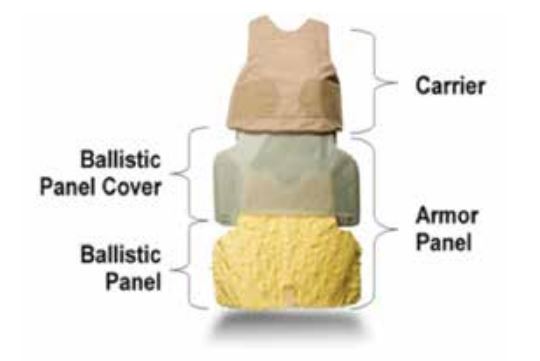
Outer Cover
The outer cover of the body armor is known as the carrier vest. It is usually made from durable, abrasion-resistant fabric such as nylon or polyester. The carrier vest features adjustable straps or Velcro closures to allow for a customized and secure fit to the wearer’s body.
Ballistic Panels
The primary component of the body armor is the ballistic panels, which are inserted into pockets within the carrier vest. Soft armor panels are made from layers of high-strength synthetic fibers such as aramid (e.g., Kevlar) or ultra-high-molecular-weight polyethylene (e.g., Spectra Shield). These panels are constructed with multiple layers of ballistic material that work together to absorb and dissipate the energy of incoming projectiles. The layers of ballistic material are often stitched together in a grid pattern to prevent shifting and maintain the integrity of the armor.
Kevlar was discovered by chance during research aimed at finding solutions for tire reinforcement. A team at DuPont in Delaware were investigating new polymer formulations in the 1960s when they stumbled upon the unique properties of the polymer solution that would become Kevlar.
Trauma Plate
Some body armor vests include trauma plates, which are rigid inserts made from materials such as ceramic, steel, or composite alloys. They are inserted into specially designed pockets within the carrier vest, typically positioned over vital organs such as the chest and back. Trauma plates provide additional protection against high-velocity rifle rounds and blunt force trauma, further reducing the risk of injury to the wearer.
Design & Mobility
Body armor vests typically provide protection to the front and back of the wearer’s torso. Some vests may also include side panels for additional coverage. Many modern body armor vests feature MOLLE (Modular Lightweight Load-carrying Equipment) webbing, allowing for the attachment of modular pouches and accessories such as magazine pouches, medical kits, or radios. Concealable body armor vests are designed to be worn discreetly under clothing, with a low-profile appearance to minimize visibility.
Some carrier vests feature breathable mesh panels or moisture-wicking materials to improve airflow and comfort during extended wear. The design of body armor vests often incorporates articulated panels and ergonomic shaping to allow for a full range of motion and maximum mobility for the wearer.
Effectiveness
Body armor is classified into different levels based on the types of threats it can protect against. This classification system typically includes levels such as Level I (lowest protection against handgun rounds) to Level IV (highest protection against rifle rounds).
The effectiveness of bulletproof vests is evaluated according to standards set by organizations such as the National Institute of Justice (NIJ). Vests are tested against specific ballistic threats, and their performance is rated based on their ability to stop projectiles while minimizing blunt force trauma to the wearer.
The National Institute of Justice (NIJ) is the research, development, and evaluation agency of the U.S. Department of Justice. It is dedicated to improving the understanding and application of justice-related science and technology.
While bulletproof vests offer effective protection against many firearm threats, they are not completely invulnerable and may fail to stop certain rounds or projectiles under extreme conditions. Factors such as velocity, caliber, and distance can affect the performance of body armor.
Bulletproof vests have a limited lifespan and may degrade over time due to wear and tear, exposure to environmental factors, or repeated impacts. It is essential for users to inspect their vests regularly and replace them as necessary to ensure continued protection.
Usage
Bulletproof vests are standard equipment for law enforcement officers and provide essential protection against firearms and other threats encountered in the line of duty. Military personnel use bulletproof vests and body armor as part of their personal protective equipment (PPE) to mitigate the risks of combat operations and hostile environments. Civilians, including security guards, private citizens, and individuals in high-risk professions, may also choose to wear bulletproof vests for personal protection against potential threats.
Some body armor is designed for specialized applications, such as explosive ordnance disposal (EOD) suits for bomb disposal technicians, maritime armor for naval operations, or high-cut helmets for airborne operations.
Explosive Ordnance Disposal Suits
EOD suits are designed to protect bomb disposal technicians from the blast and fragmentation effects of explosive devices. These suits typically incorporate layers of ballistic material to mitigate the impact of shrapnel and debris resulting from explosions. EOD suits may include reinforced panels, blast-resistant padding, and integrated cooling systems to enhance wearer comfort and safety during bomb disposal operations.
Fragmentation Vests
Fragmentation vests are designed to provide protection specifically against shrapnel and projectile fragments from explosive devices. These vests typically cover vital areas of the body, such as the torso, neck, and groin, to minimize the risk of injury from fragmentation.
Riot Control Gear
Riot control gear is designed to protect law enforcement officers and security personnel during crowd control and civil unrest situations. Riot control gear may include body armor with added protection against blunt force trauma from projectiles such as rocks, bottles, or other thrown objects. Riot control gear may also feature additional protective elements such as face shields, forearm guards, and groin protection.
Maritime Body Armor
Maritime body armor is designed for use by naval personnel operating in maritime environments, such as maritime security teams or maritime special operations forces. These specialized vests are often constructed from water-resistant materials and may include flotation capabilities to provide buoyancy in water.
Aviation Body Armor
Aviation body armor is designed for use by helicopter crews and aircrew operating in high-risk environments. These vests are typically lightweight and offer protection against small arms fire and fragmentation while providing freedom of movement necessary for flight operations.
Modular Systems
Some body armor systems are modular, allowing users to customize their protection levels and configurations based on mission requirements. These systems may include removable ballistic panels, accessory attachments, and compatibility with other gear.





 Battleground Archives
Leave a comment